



-
 The result of working together:ILIAS
Useful, clever, innovatively designed: ILIAS 11.
ILIAS 11 is here – with lots of improvements for a more flexible and user-friendly platform. Created as a true collaborative effort.
Developed with you and for you!
 Download ILIAS 11 now
Or would you prefer to use ILIAS 10 first?
Get off to a good start.
If you’re using ILIAS for the first time, the software can seem a bit overwhelming. With ILIAS 11, you’re guided through this process. A guided tour helps you get started and walks you through the most important steps – tailored specifically to your system.
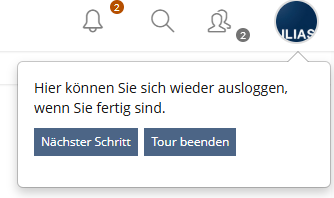
The guided tour is set up in the administration. It places prompts directly next to relevant interface elements such as tabs, forms or buttons. It can be tailored specifically to pages or roles.
Short. Shorter. Shortlinks.
No more cryptic URLs: ILIAS now supports short links.
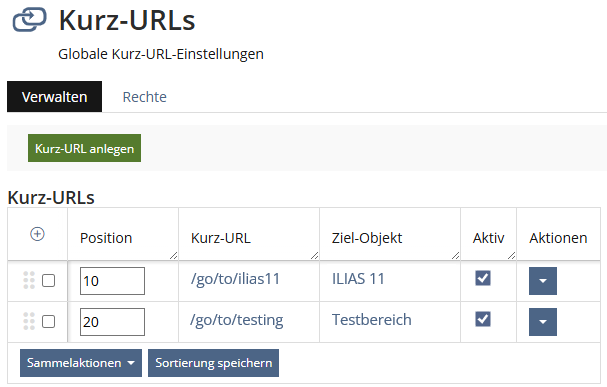
Short URLs can now be assigned in the administration, for example ‘/ilias11’ for a category. This makes content directly and easily accessible. Perfect for public websites and frequently shared links.
Related to this topic: With ILIAS 11, the certificate overview now has its own permalink. This allows users to access their individual overview quickly and easily.
Marking tests: question by question, participant by participant
ILIAS offers a powerful e-assessment tool. With each new version, user-friendliness is improved and the code becomes more efficient. In ILIAS 11, the scoring system in particular has been overhauled – and the results are truly impressive.
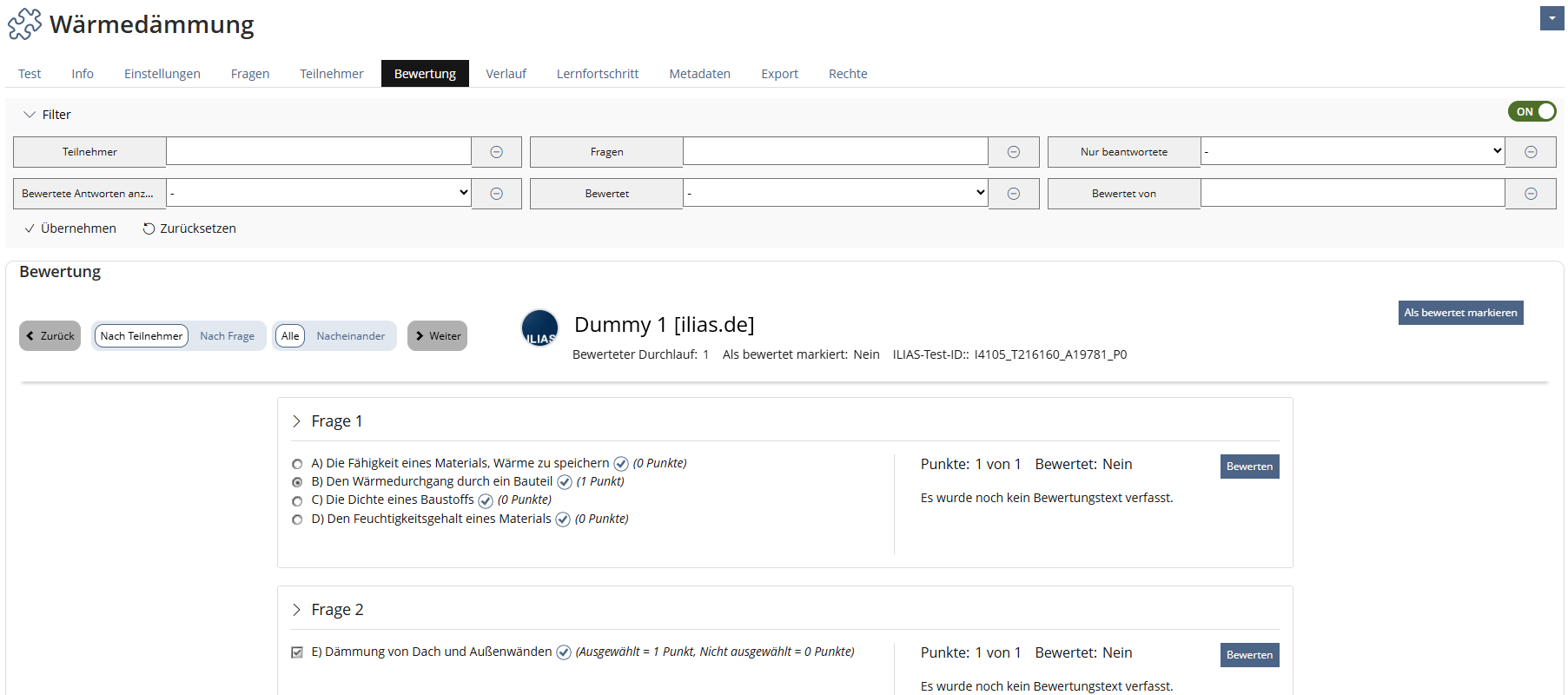
The "Scoring" tab has been extensively revised in ILIAS 11 and made more flexible. Scores can now be conducted either on a participant-by-participant basis or on a question-by-question basis. It is also possible to choose whether all questions are displayed simultaneously or individually (One by One / All). This allows you to either assess a participant step by step or go through a single question one by one for all participants.
To complement this, the new "Score anonymously" permission has been introduced. It allows tests to be marked without access to the test settings (unless this permission has also been granted). Only individual test IDs are displayed; no names are shown.
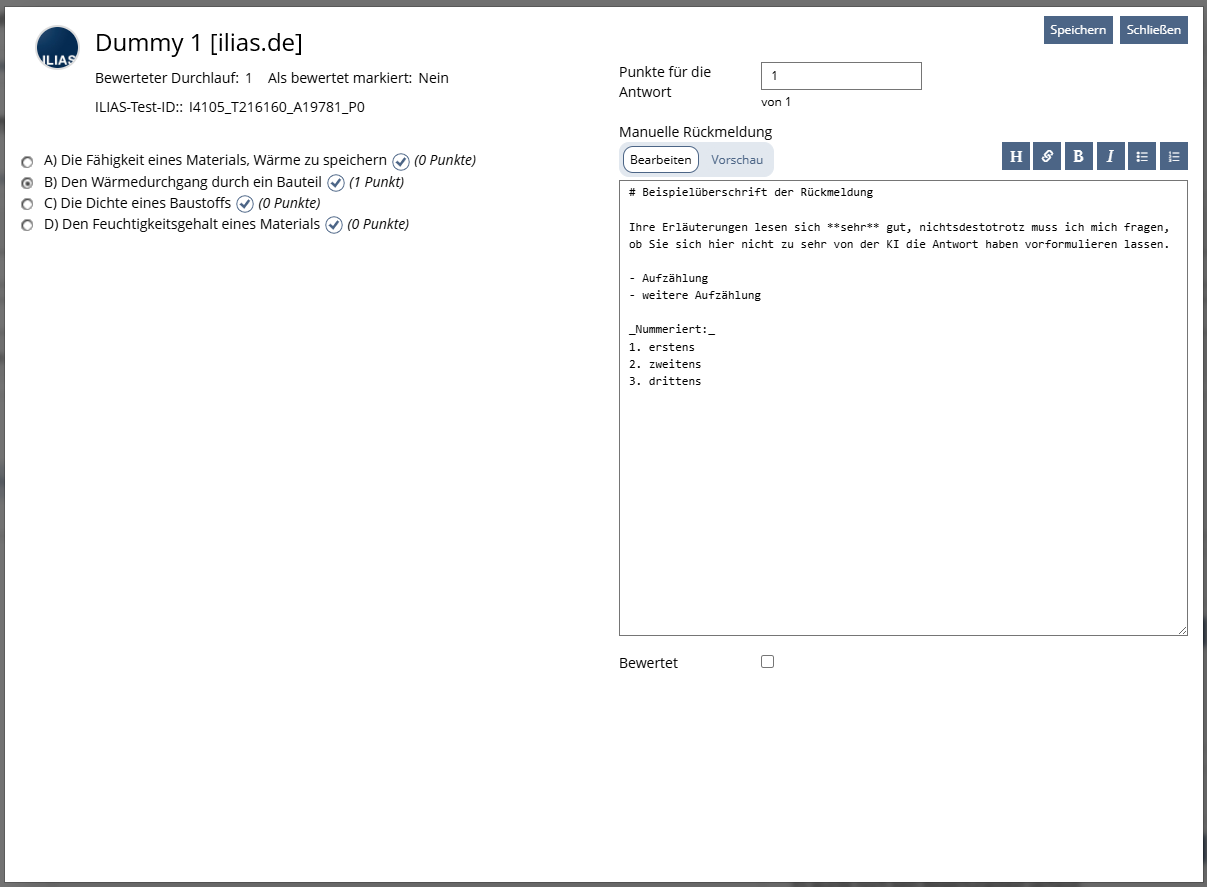
Feedback can now also be formatted using Markdown in the "Scoring" tab. This allows you to structure text with headings, bold text, lists or links. The feedback is created in a modal window directly within the work context.
Preconditions have long been a tried-and-tested method in ILIAS for unlocking content in a targeted manner and designing individual learning paths. Until now, it was mainly possible to take into account statuses such as ‘in progress’ or ‘passed’.
A new feature in ILIAS 11 is that specific score ranges can also be used as preconditions. To this end, minimum and maximum percentage values can be defined, to which the release of further content is linked. This allows learning activities to be managed in an even more nuanced way.
For example: if a score of 0–30% is achieved in a test, a specific follow-up test is unlocked. At 31–50%, another one is unlocked, and so on. In this way, content can be tailored specifically to individual performance levels and different learning pathways can be mapped out.
The templates for personal test settings have been significantly redesigned. They can now also be exported and imported. They are no longer selected during the creation process, but via the relevant sub-tab within the settings.
Your learning progress at a glance:
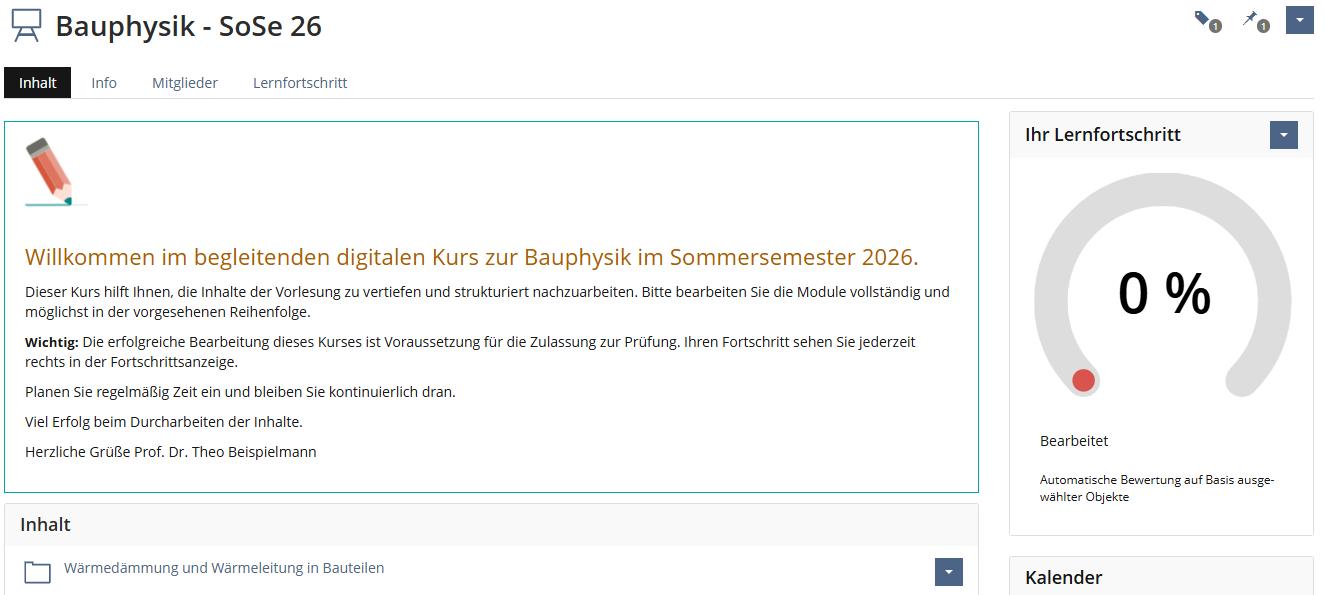
With ILIAS 11, learning progress becomes more visible.
A progress bar can be enabled in the learning progress settings. This displays the completion status as a percentage – directly within the course, above the calendar.
ILIAS now also uses this display in the "Learning Outcomes" section (main menu).
Achieving more together: Open Educational Resources
Open Educational Resources (OER) are freely accessible educational materials licensed under open licences such as Creative Commons. They may be used and adapted in accordance with these licences. ILIAS 11 now offers even more options for finding and sharing OER documents!
The so-called OER Harvester has been in use for many years. When materials are made available under a Creative Commons licence, ILIAS automatically detects them and creates export files where none exist. The OER materials are then published in a category set up specifically for this purpose.
To date, files, learning modules, glossaries, content pages, question pools for surveys and tests, and media pools have been included.
With ILIAS 11, further object types are being added: Mediacasts, exercises, wikis, data collections, web links and blogs.
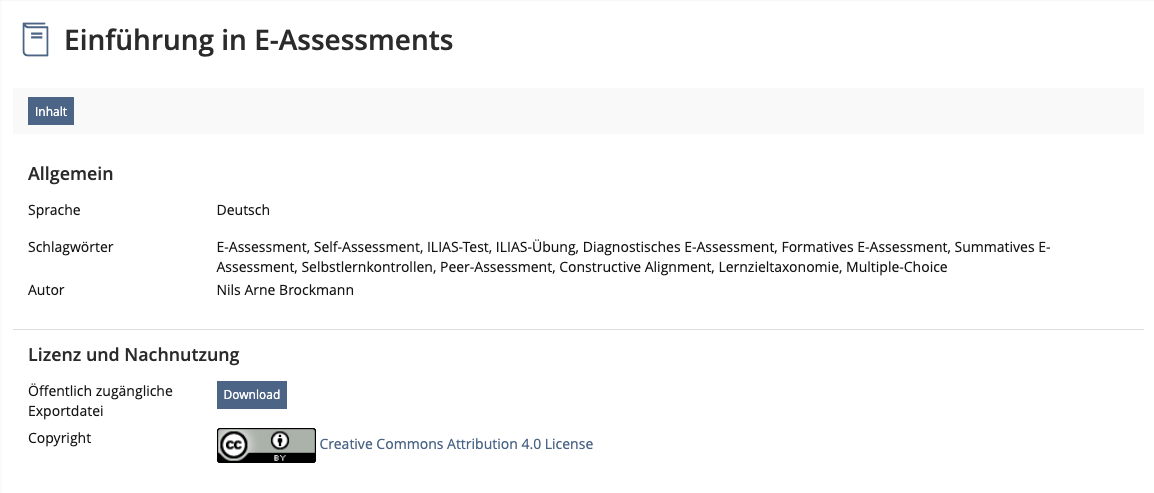
The advanced search now includes a licence filter. This allows you to find specific OER content – provided you have read access to the materials.
The search interface has also been updated and adapted to the current ILIAS design. This has successfully reduced legacy code.
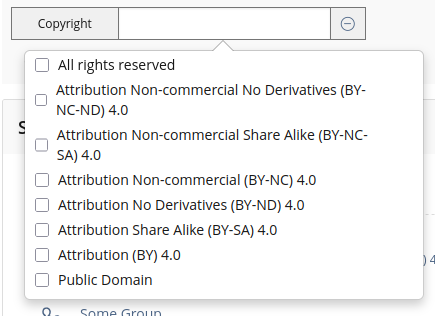
Many OER materials consist of complete course structures. Content builds on previous material and must first be unlocked or worked through. Preconditions are a proven way of guiding learning processes in a targeted manner. How useful would it be if these rules were retained directly during export?
With ILIAS 11, this is exactly what is possible. When exporting containers, preconditions are transferred – provided that the respective target object is also part of the container. This means that when importing extensive OER content, there is no need to set up the preconditions again. Very practical!

Changes to the data collection:
Several improvements have been made to the data collection in ILIAS 11. New options make it easier to use and offer greater flexibility in day-to-day work.
Personalised notifications
Users can now choose for themselves what they would like to be notified about via email. They can select from new, updated and deleted posts. This ensures that everyone stays up to date with exactly the changes that are relevant to them.
New field types for date and time
Two new field types have been added to the data collection: selecting a date and time, and entering a date and time. Previously, it was only possible to enter a date without a time. This now allows time-related information to be recorded much more precisely.
Placeholders for views
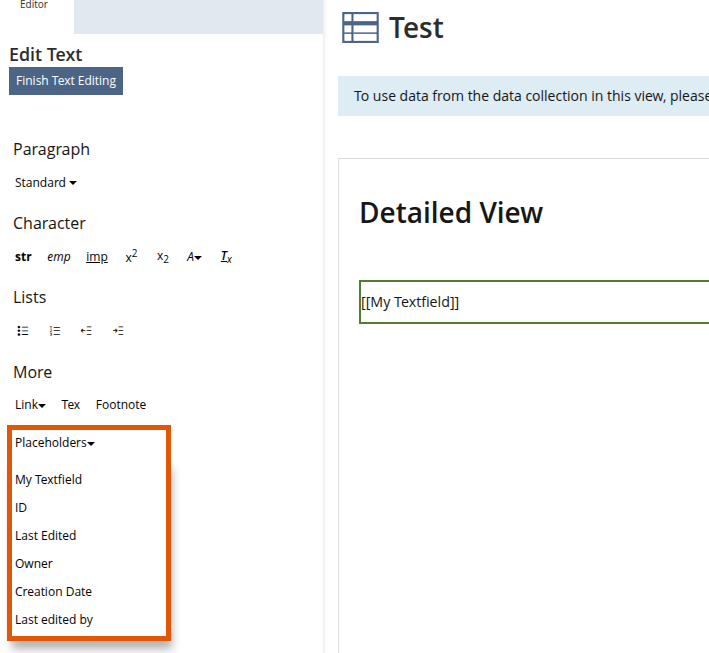
In the detailed views, entries in a data collection can be enhanced with additional information and visually formatted. The contents of individual fields can be inserted using placeholders. Previously, these had to be inserted as text paragraphs. With ILIAS 11, they are now available directly in the page editor’s slate. This makes them easier to use and significantly simplifies the process of designing content.
More options for sending emails
The email function has also been improved in ILIAS 11 and now offers greater flexibility when writing and sending messages.
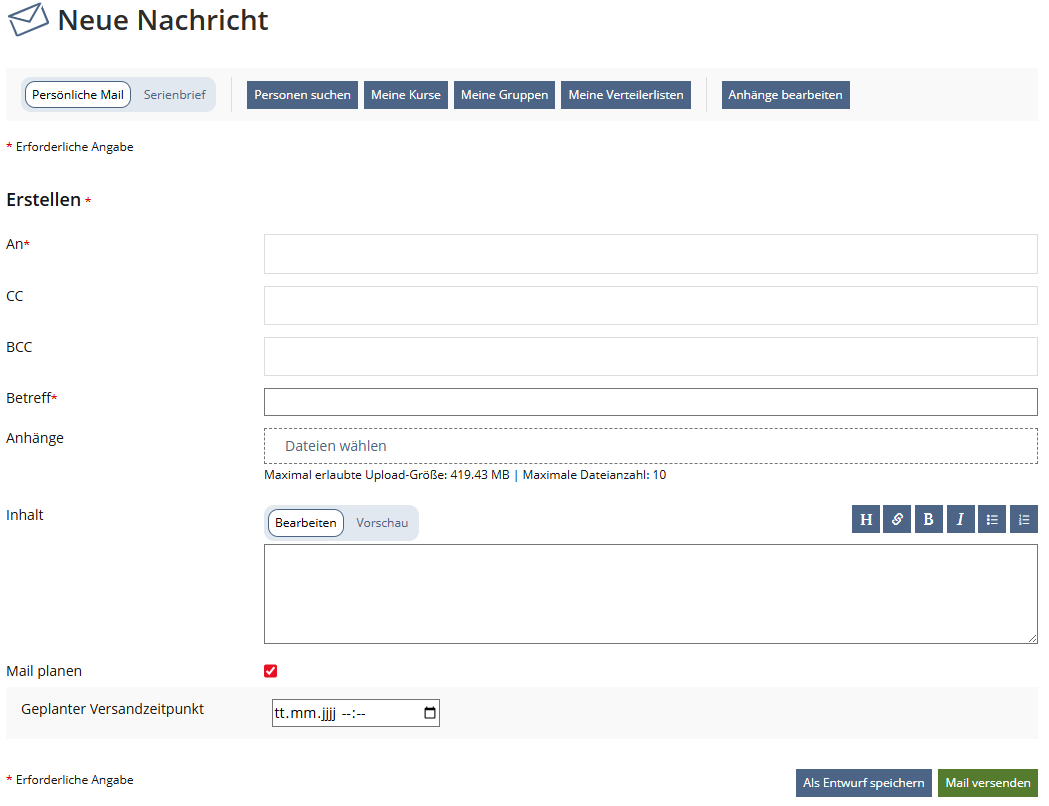
Markdown for formatted emails
Emails now feature a Markdown input field. This allows you to structure and format text directly within the email, for example by using bold text, lists or paragraphs. This makes emails easier to read.
Scheduled emails
Emails can now be scheduled and set to be sent at a specific time. They remain stored in the outbox until they are sent. Drafts are also managed in this way, but are not sent automatically when the scheduled time is reached.
Want to get started right now?
Everything you need for the installation of ILIAS 11 can be found here: